
Calculator
Calorie deficit calculator: how to count your deficit
To count a calorie deficit, estimate your maintenance calories (TDEE), then subtract a daily amount, usually 250 to 500 calories for a gradual loss of about 0.25 to 0.5 kg (0.5 to 1 lb) per week. This calculator does both steps and shows your daily target. Results are estimates, not medical advice.
Get it on Google Play → Join the iPhone waitlist Available on Android. iPhone coming soon. Free to start.
Calculate your calorie deficit
How do I calculate a calorie deficit?
First estimate maintenance calories, the energy you burn in a day, using the Mifflin-St Jeor formula for resting energy multiplied by an activity factor. Then subtract your chosen deficit. Eating below maintenance by about 500 calories a day is a common starting point for losing roughly 0.5 kg (1 lb) per week.
Men: BMR = 10 × weight (kg) + 6.25 × height (cm) − 5 × age + 5
Women: BMR = 10 × weight (kg) + 6.25 × height (cm) − 5 × age − 161
Maintenance (TDEE) = BMR × activity factor (1.2 to 1.9)
How big should a calorie deficit be?
A gradual deficit of about 250 to 500 calories a day is a common choice, because very large deficits are harder to sustain and can cost muscle and energy. Larger deficits should only be used under medical supervision. This calculator never goes below 1,200 calories for women or 1,500 for men.
How many calories is a 500 calorie deficit?
A 500 calorie deficit every day adds up to about 3,500 calories a week, which the common rule of thumb equates to roughly 0.45 kg (1 lb) of body weight. Real results vary, and weight loss usually slows over time as your body changes, so treat it as a rough guide.
Is a calorie deficit safe for everyone?
No. Do not use a calorie deficit without medical advice if you are pregnant or breastfeeding, under 18, have diabetes or another medical condition, take medication, or have or may have an eating disorder. Speak to a doctor or registered dietitian first. Stopping is always an option.
Maintenance calorie factors
| Activity level | Factor |
|---|---|
| Sedentary (desk job, little exercise) | 1.2 |
| Lightly active (exercise 1-3 days a week) | 1.375 |
| Moderately active (3-5 days a week) | 1.55 |
| Very active (6-7 days a week) | 1.725 |
| Extra active (physical job or training twice a day) | 1.9 |
Track your deficit in the app


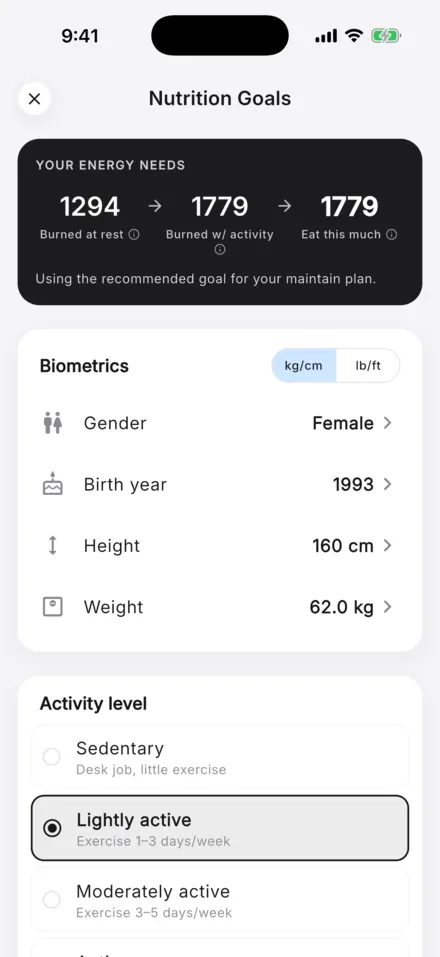
A deficit only works if you know what you eat. AI Calorie estimates calories from a photo or a short description, so you can log meals quickly. It is free to start with daily limits: see pricing.
Sources
- Mifflin MD, St Jeor ST, et al. "A new predictive equation for resting energy expenditure in healthy individuals." Am J Clin Nutr 1990;51(2):241-247. doi:10.1093/ajcn/51.2.241
- Wishnofsky M. "Caloric equivalents of gained or lost weight." Am J Clin Nutr 1958;6(5):542-546. (Origin of the 3,500 calories per pound rule of thumb.)
- Hall KD, Sacks G, Chandramohan D, et al. "Quantification of the effect of energy imbalance on bodyweight." Lancet 2011;378(9793):826-837. (Shows the rule of thumb is a simplification and weight loss slows over time.)
AI Calorie gives general nutrition information and AI-generated estimates. It is not medical advice. See medical review and our Terms of Use.