
TDEE calculator
TDEE calculator: find your total daily energy expenditure
Your TDEE, or total daily energy expenditure, is the number of calories you burn in a day including activity. It is your basal metabolic rate (BMR) multiplied by an activity factor. This calculator uses the Mifflin-St Jeor formula and shows your TDEE at every activity level. Results are estimates, not medical advice.
Get it on Google Play → Join the iPhone waitlist Available on Android. iPhone coming soon. Free to start.
Use the TDEE calculator
What is TDEE?
TDEE stands for total daily energy expenditure, the calories your body uses in a day. It adds your resting energy (BMR), the energy to digest food, everyday movement and exercise. Eating at your TDEE roughly maintains your weight, eating below it tends to lose weight, and above it tends to gain.
What is the difference between BMR and TDEE?
BMR is the calories your body burns at complete rest to keep you alive, such as breathing and circulation. TDEE is BMR plus everything else you do, so it is always higher. TDEE is the number to use when planning how much to eat.
Men: BMR = 10 × weight (kg) + 6.25 × height (cm) − 5 × age + 5
Women: BMR = 10 × weight (kg) + 6.25 × height (cm) − 5 × age − 161
How accurate is a TDEE calculator?
A TDEE calculator gives an estimate, not a measurement. The Mifflin-St Jeor formula is based on healthy adults, and real needs vary with muscle mass, genetics, medication and how accurately you judge your activity. Compare the result with your actual weight trend over two to three weeks and adjust.
| Activity level | Factor |
|---|---|
| Sedentary (desk job, little exercise) | 1.2 |
| Lightly active (exercise 1-3 days a week) | 1.375 |
| Moderately active (3-5 days a week) | 1.55 |
| Very active (6-7 days a week) | 1.725 |
| Extra active (physical job or training twice a day) | 1.9 |
Should I eat at my TDEE?
Eating at your TDEE aims to keep your weight steady. To lose weight, most people eat somewhat below it, and to gain they eat somewhat above. Large gaps are hard to sustain. If you have a medical condition or are unsure, speak to a doctor or dietitian first.
See also the calorie calculator and calorie deficit calculator.
Log what you eat in the app


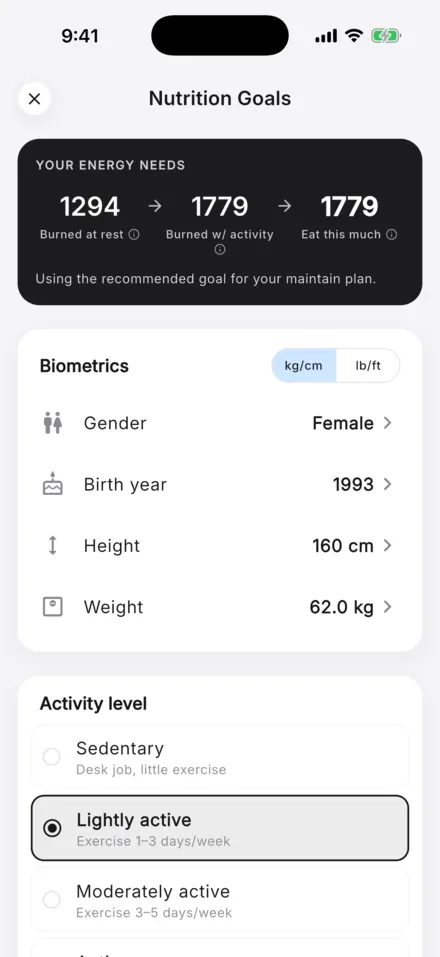
A target only helps if you know what you eat. AI Calorie estimates calories and macros from a photo or a short description. It is free to start with daily limits: see pricing. This calculator is not medical advice; see medical review.
Sources
- Mifflin MD, St Jeor ST, et al. "A new predictive equation for resting energy expenditure in healthy individuals." Am J Clin Nutr 1990;51(2):241-247. doi:10.1093/ajcn/51.2.241
AI Calorie gives general nutrition information and AI-generated estimates. It is not medical advice. See medical review and our Terms of Use.